
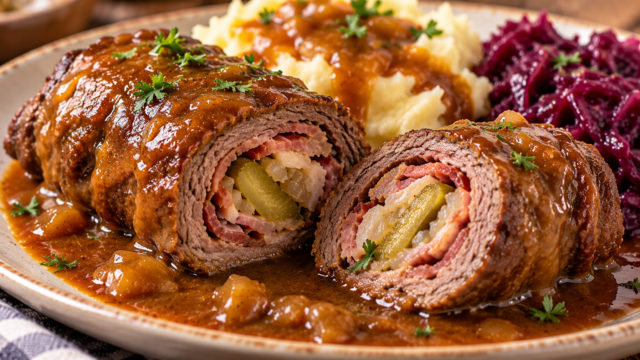
German Rouladen is a traditional German comfort food made with thin slices of beef wrapped around smoky bacon, tangy dill pickles, onions, and a generous spread of German mustard.
The beef rolls are browned until beautifully caramelized, then slowly braised in a rich, savory brown gravy until fork-tender. Each slice reveals a delicious spiral of beef, bacon, and pickles, with the sharp mustard and tangy filling perfectly balancing the deep, hearty flavors of the gravy.
This old-fashioned German dinner has been a family favorite for generations, especially for Sunday suppers, holidays, and special occasions.
Although German Rouladen looks impressive on the plate, it’s surprisingly straightforward to prepare with simple ingredients and a little patience. The secret is browning the beef rolls before braising them slowly, allowing the meat to become tender while creating a flavorful gravy from the pan drippings. Serve with creamy mashed potatoes, traditional German potato dumplings, or buttery egg noodles to soak up every last spoonful of gravy.
Prep Time: 25 minutes
Cook Time: 1 hour 45 minutes
Total Time: 2 hours 10 minutes
Servings: 6
Yield: 6 beef rouladen
Ingredients
For the Beef Rouladen
- 6 thin slices beef top round or bottom round, approximately 5 to 6 ounces each
- 6 tablespoons German-style mustard or Dijon mustard
- 12 slices bacon, preferably thin-cut
- 2 medium yellow onions, thinly sliced
- 3 medium dill pickles, cut lengthwise into 12 spears
- 1 teaspoon kosher salt
- 1/2 teaspoon freshly ground black pepper
- 2 tablespoons vegetable oil
- 2 tablespoons unsalted butter
For the Brown Gravy
- 1 medium yellow onion, diced
- 1 large carrot, diced
- 1 celery stalk, diced
- 2 cloves garlic, minced
- 2 tablespoons tomato paste
- 1/2 cup dry red wine, optional
- 3 cups low-sodium beef broth
- 1 tablespoon Worcestershire sauce
- 1 teaspoon German-style mustard or Dijon mustard
- 2 bay leaves
- 1/2 teaspoon dried thyme
- 2 tablespoons all-purpose flour
- 2 tablespoons unsalted butter, softened
- Salt and freshly ground black pepper, to taste
Directions
- Prepare the beef: Lay the beef slices on a clean cutting board. If necessary, place each slice between two sheets of plastic wrap and gently pound with a meat mallet until approximately 1/4 inch thick. The slices should be large enough to roll around the filling, ideally about 4 inches wide and 8 inches long. Pat the beef dry with paper towels.
- Season and spread with mustard: Sprinkle both sides of the beef slices lightly with the salt and black pepper. Spread approximately 1 tablespoon of German mustard over one side of each slice, covering most of the surface.
- Add the traditional filling: Place 2 slices of bacon lengthwise over the mustard on each piece of beef. Divide the sliced onions evenly among the 6 portions, arranging them near one short end of each slice. Add 2 dill pickle spears to each portion.
- Roll the beef: Starting at the short end containing the onions and pickles, roll each piece of beef tightly around its filling. Fold the long sides inward slightly as you roll to help contain the ingredients. Secure each rouladen with kitchen twine or 2 to 3 wooden toothpicks.
- Brown the rouladen: Heat the vegetable oil and 2 tablespoons of butter in a large Dutch oven or heavy-bottomed pot over medium-high heat. Once the butter has melted and the pan is hot, add the beef rolls in batches, seam-side down first. Brown for approximately 2 to 3 minutes per side, turning carefully until all sides develop a deep golden-brown crust. Transfer the browned rouladen to a plate. They do not need to be cooked through at this stage.
- Cook the gravy vegetables: Reduce the heat to medium. Add the diced onion, carrot, and celery to the same pot. Cook for 5 to 7 minutes, stirring occasionally, until the vegetables soften and begin to brown. Add the minced garlic and cook for another 30 seconds until fragrant.
- Develop the gravy flavor: Stir the tomato paste into the vegetables and cook for 1 to 2 minutes, allowing it to darken slightly. This adds depth and a rich color to the finished gravy.
- Deglaze the pot: Pour in the red wine, if using, and scrape the bottom of the pot with a wooden spoon to release the browned bits. Simmer for 2 to 3 minutes until the wine reduces slightly. If omitting the wine, use an additional 1/2 cup of beef broth instead.
- Add the braising liquid: Pour in the 3 cups of beef broth, then stir in the Worcestershire sauce, mustard, bay leaves, and dried thyme. Bring the mixture to a gentle simmer.
- Braise the beef: Return the browned rouladen and any accumulated juices to the pot, nestling the rolls into the liquid. The liquid should reach approximately halfway to two-thirds of the way up the beef rolls. Cover with a tight-fitting lid and reduce the heat to low. Simmer gently for 75 to 90 minutes, turning the rouladen once halfway through cooking, until the beef is fork-tender. Add a little more broth if the liquid reduces excessively.
- Remove the rouladen: Carefully transfer the tender beef rolls to a serving platter and cover loosely with aluminum foil to keep warm. Remove and discard the bay leaves from the braising liquid.
- Strain the gravy: For a traditional smooth brown gravy, pour the braising liquid through a fine-mesh strainer into a clean saucepan, pressing gently on the cooked vegetables to extract their flavor. Discard the solids. Alternatively, blend the cooked vegetables into the liquid using an immersion blender for a thicker, more rustic gravy.
- Thicken the gravy: In a small bowl, mash together the softened butter and flour until a smooth paste forms. Bring the strained gravy to a gentle simmer over medium heat. Whisk in the butter-flour paste a little at a time until fully incorporated. Simmer for 3 to 5 minutes, whisking frequently, until the gravy thickens enough to coat the back of a spoon. Taste and adjust the salt and pepper as needed.
- Finish the rouladen: Remove the kitchen twine or toothpicks from each beef roll. Return the rouladen to the saucepan with the finished gravy and spoon the sauce over the top. Warm gently for 2 to 3 minutes before serving.
- Serve: Arrange the German Rouladen on individual plates or a large serving platter. For a beautiful presentation, slice one or two rolls diagonally to reveal the spiral of beef, bacon, onion, and pickle filling. Spoon generous amounts of the rich brown gravy over the beef and serve with mashed potatoes, German potato dumplings, or buttered egg noodles.
Chefs Notes
- Choose the right beef: Top round or bottom round works best for German Rouladen because these cuts can be sliced thinly and become tender during slow braising. Ask your butcher for beef sliced specifically for rouladen if available.
- Don’t skip the mustard: German-style mustard provides the traditional tangy flavor that balances the bacon and pickles. Medium-hot German mustard is especially good, but Dijon is an excellent substitute.
- Use dill pickles: Traditional German Rouladen typically contains dill pickles rather than sweet pickles. Their acidity cuts through the richness of the beef and gravy.
- Raw bacon is traditional: The bacon goes into the beef rolls uncooked. It slowly cooks during braising, releasing its smoky, savory flavor into the filling.
- Secure the rolls tightly: Kitchen twine is especially useful for keeping the rouladen intact during browning and braising. Wooden toothpicks also work, but remember to remove every toothpick before serving.
- Brown the beef thoroughly: Developing a deep brown crust on the outside of the rouladen creates flavorful pan drippings that form the foundation of the gravy.
- Keep the braise gentle: The beef should simmer slowly rather than boil vigorously. A gentle braise helps the meat become tender without tightening or drying out.
- Allow extra time if needed: Some cuts of beef may require closer to 2 hours of braising to become fully tender. The rouladen are ready when a fork slides easily into the meat.
- Make the gravy richer: For a deeper flavor, add an extra teaspoon of tomato paste or a small splash of Worcestershire sauce. Taste before adding more salt because the bacon, mustard, pickles, and broth already contribute saltiness.
- Traditional German side dishes: Serve German Rouladen with Kartoffelklöße (German potato dumplings), Rotkohl (sweet-and-sour red cabbage), or creamy mashed potatoes. Spaetzle and buttered egg noodles are also excellent choices.
- Make-ahead tip: German Rouladen often tastes even better the next day. Prepare the beef and gravy a day ahead, refrigerate, and reheat gently before serving.
- Storage: Refrigerate leftover rouladen and gravy in an airtight container for up to 3 to 4 days. Keep the beef covered with gravy to help prevent drying.
- Freezing: Freeze cooled rouladen in their gravy in a freezer-safe container for up to 3 months. Thaw overnight in the refrigerator before reheating.
- Reheating: Warm the rouladen in a covered saucepan over low heat, adding a splash of beef broth if the gravy has thickened. Heat until the beef is thoroughly warmed through.
- Presentation suggestion: Slice one rouladen in half at an angle and place it beside a whole roll, allowing the colorful spiral of bacon, pickles, and onions to show. Spoon glossy brown gravy around the beef for an appetizing, traditional presentation.