
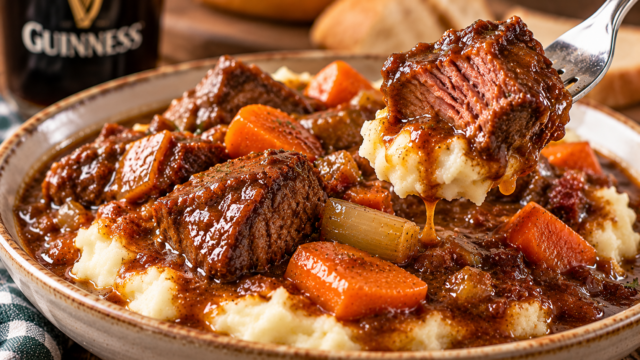
Guinness Beef Stew is a hearty Irish-inspired comfort food made with tender chunks of beef chuck, smoky bacon, carrots, onions, and celery simmered in a rich, dark gravy.
Guinness stout gives the broth its distinctive deep flavor, adding malty, roasted notes that complement the savory beef and vegetables. As the stew cooks slowly, the meat becomes fork-tender, the vegetables soften, and the broth develops into a thick, flavorful gravy that’s perfect for spooning over a generous helping of creamy mashed potatoes.
This old-fashioned beef stew is surprisingly easy to prepare, even though it tastes like something that’s been cooking in a farmhouse kitchen all day. The secret is browning the beef in rendered bacon fat, then using Guinness to loosen all those flavorful browned bits from the skillet.
Everything simmers together in one pot until the beef is tender enough to pull apart with a fork. It’s a wonderful cold-weather dinner, a satisfying Sunday supper, or a comforting meal for St. Patrick’s Day. Serve it with buttery mashed potatoes or thick slices of crusty bread to soak up every last drop of the dark, savory gravy.
Prep Time: 30 minutes
Cook Time: 2 hours 30 minutes
Total Time: 3 hours
Servings: 6
Ingredients
For the Beef Stew
- 4 slices bacon, chopped into small pieces
- 2 1/2 pounds boneless beef chuck roast, cut into 2-inch cubes
- 1 1/2 teaspoons kosher salt, divided, plus more to taste
- 1/2 teaspoon freshly ground black pepper, plus more to taste
- 2 medium yellow onions, coarsely chopped
- 4 cloves garlic, minced
- 1 (14.9-ounce) can Guinness stout or another dark Irish stout
- 1/4 cup tomato paste
- 3 medium carrots, peeled and cut into 1-inch pieces
- 2 celery ribs, cut into 1-inch pieces
- 4 sprigs fresh thyme
- 1 teaspoon granulated sugar
- 2 1/2 cups low-sodium chicken stock, or enough to nearly cover the beef and vegetables
For Serving
- 4 cups prepared mashed potatoes, optional
Directions
- Prepare the ingredients: Cut the beef chuck into approximately 2-inch cubes, trimming away any large pieces of tough connective tissue while leaving some marbling for flavor. Chop the bacon, onions, carrots, and celery, and mince the garlic. Pat the beef dry with paper towels to help it brown properly.
- Cook the bacon: Place a large, heavy-bottomed skillet over medium heat. Add the chopped bacon and cook for 4 to 6 minutes, stirring occasionally, until browned and crispy and most of the fat has rendered. Using a slotted spoon, transfer the bacon to a large Dutch oven or heavy stew pot, leaving the rendered bacon fat in the skillet.
- Season the beef: Sprinkle the beef cubes with 1 teaspoon of the salt and the 1/2 teaspoon of black pepper. Toss gently to coat the meat evenly.
- Brown the beef: Increase the skillet heat to medium-high. Working in batches to avoid overcrowding, add the beef cubes to the hot bacon fat. Sear for approximately 2 to 3 minutes per side, turning until the exposed surfaces develop a deep brown crust. Transfer the browned beef to the stew pot with the bacon. Repeat with the remaining beef, leaving the flavorful drippings in the skillet.
- Cook the onions: Reduce the skillet heat to medium. Add the chopped onions to the remaining drippings and sprinkle with the remaining 1/2 teaspoon of salt. Cook for 5 to 8 minutes, stirring occasionally, until softened and lightly golden. If the skillet becomes too dry, add a tablespoon of chicken stock.
- Add the garlic: Stir the minced garlic into the onions and cook for approximately 1 minute, just until fragrant. Avoid letting the garlic burn.
- Deglaze with Guinness: Slowly pour the Guinness stout into the skillet. Use a wooden spoon to scrape the bottom of the pan, releasing the browned bits left behind by the bacon, beef, and onions. Bring the liquid to a gentle simmer and cook for 2 minutes to combine the flavors.
- Combine the stew ingredients: Pour the Guinness and onion mixture into the stew pot with the browned beef and bacon. Add the tomato paste, carrots, celery, fresh thyme sprigs, and granulated sugar. Stir until the tomato paste is evenly distributed.
- Add the stock: Pour in approximately 2 1/2 cups of chicken stock, adding just enough to nearly cover the beef and vegetables. Stir gently to combine. The liquid will gradually develop into a rich, dark gravy as the stew simmers.
- Bring to a simmer: Place the stew pot over medium heat and bring the mixture to a gentle simmer. Once small bubbles begin breaking at the surface, reduce the heat to low and cover the pot with a tight-fitting lid.
- Slow-cook the stew: Simmer gently for approximately 2 hours, stirring occasionally, until the beef is very tender and can be easily pierced or pulled apart with a fork. Keep the liquid at a low simmer rather than a rolling boil. If the stew becomes too thick during cooking, add a small splash of stock or water.
- Reduce the gravy: Once the beef is tender, remove the lid and increase the heat to medium. Allow the stew to simmer uncovered for another 15 to 20 minutes, stirring occasionally, until the liquid reduces slightly and develops a thicker, glossy consistency.
- Adjust the seasoning: Remove and discard the thyme sprigs. Taste the stew and add additional salt and freshly ground black pepper as needed. If the Guinness flavor is slightly bitter, allow the stew to simmer a few minutes longer or add a small pinch of sugar to balance the flavors.
- Prepare the mashed potatoes: If serving with mashed potatoes, prepare approximately 4 cups using your favorite recipe. Keep them warm until the stew is ready.
- Serve: Spoon a generous portion of mashed potatoes into a shallow serving bowl, forming a slight well in the center. Ladle the hot Beef and Guinness Stew into the well, allowing the rich brown gravy to flow around the potatoes. Make sure each serving includes plenty of tender beef, carrots, onions, and bacon. Serve immediately while hot.
Chefs Notes
- Choose beef chuck: Boneless chuck roast is ideal for this stew because its marbling and connective tissue soften during slow cooking, producing tender, flavorful beef. Lean cuts such as sirloin may become dry during prolonged simmering.
- Brown the meat in batches: Avoid crowding the skillet. Browning the beef in smaller batches creates a flavorful crust and helps develop the deep, savory character of the finished gravy.
- Why Guinness works: Guinness stout contributes roasted malt flavors and a subtle bitterness that balances the richness of the beef and bacon. Its dark color also gives the gravy an appetizing deep brown appearance.
- Use chicken stock for balance: Chicken stock creates a savory broth without overpowering the stout. Beef stock can be substituted for a stronger beef flavor, although the finished gravy may taste slightly heavier.
- Don’t rush the simmer: Beef chuck needs time for its connective tissue to soften. If the meat is still chewy after 2 hours, continue simmering in 15-minute intervals until fork-tender.
- For thicker gravy: If the stew remains thinner than desired after reducing, mix 1 tablespoon cornstarch with 1 tablespoon cold water. Stir the mixture into the simmering stew and cook for 1 to 2 minutes until thickened.
- Balance the bitterness: Some dark stouts have a noticeable bitter edge. The tomato paste, onions, carrots, and small amount of sugar help balance this flavor. Taste the finished stew before adding additional sugar.
- Optional additional vegetables: Add 8 ounces of quartered cremini mushrooms during the final 45 minutes of cooking for a heartier stew. Small potatoes can also be added, although they aren’t necessary when serving the stew over mashed potatoes.
- Traditional serving ideas: Serve Beef and Guinness Stew with creamy mashed potatoes, Irish colcannon, buttered egg noodles, or thick slices of rustic bread. Mashed potatoes are especially good for soaking up the dark gravy.
- Make-ahead tip: This stew often develops even deeper flavor after resting overnight in the refrigerator. Prepare it a day ahead, cool promptly, and reheat gently before serving.
- Storage: Refrigerate leftover stew in an airtight container for up to 3 to 4 days. Store mashed potatoes separately for the best texture.
- Freezing: Allow the stew to cool completely, then transfer it to freezer-safe containers. Freeze for up to 3 months for the best quality. Thaw overnight in the refrigerator before reheating.
- Reheating: Warm leftover stew in a covered saucepan over medium-low heat, stirring occasionally, until heated through. Add a splash of chicken stock or water if the gravy has thickened during storage.
- Presentation suggestion: For an especially appetizing presentation, serve the stew in a shallow bowl with a generous mound of buttery mashed potatoes. Position several large pieces of beef and bright orange carrots on top, then spoon the glossy Guinness gravy over everything.