
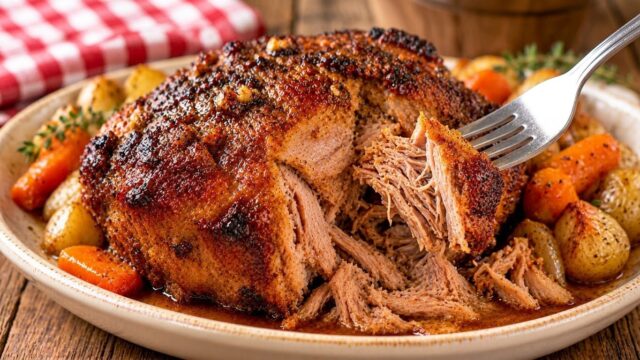
Dead Simple Pork Roast is a tender, juicy, slow-roasted pork shoulder covered in a sticky brown sugar, garlic, and apple cider glaze.
The outside develops a deeply caramelized crust with crispy, flavorful edges, while the inside becomes so soft it practically falls apart with a fork. A simple combination of Dijon mustard, brown sugar, apple cider, garlic, and savory seasonings creates a rich pan sauce that soaks into every bite.
It’s the kind of old-fashioned comfort food that looks like it took all day to prepare, even though most of the cooking happens without any effort.
This easy pork roast is perfect for Sunday dinners, family gatherings, or a hearty meal when you want something impressive without spending hours in the kitchen. The pork shoulder slowly cooks in the oven until the connective tissue breaks down, leaving the meat incredibly tender and flavorful.
A quick blast of high heat at the end helps caramelize the sweet and savory glaze into a beautiful golden-brown crust. Serve Dead Simple Pork Roast with roasted potatoes, carrots, mashed potatoes, or buttered vegetables, and spoon the rich cooking juices over the meat for an unforgettable homemade dinner.
Prep Time: 15 minutes
Cook Time: 4 hours 30 minutes to 5 hours
Resting Time: 20 minutes
Total Time: 5 hours 5 minutes to 5 hours 35 minutes
Servings: 8
Yield: 1 (4 to 5-pound) pork roast
Ingredients
For the Pork Roast
- 1 (4 to 5-pound) boneless pork shoulder roast, preferably Boston butt
- 2 tablespoons olive oil
- 2 teaspoons kosher salt
- 1 teaspoon freshly ground black pepper
- 2 teaspoons smoked paprika
- 1 teaspoon onion powder
- 1 teaspoon dried thyme
- 1 large yellow onion, cut into thick wedges
- 6 cloves garlic, minced
- 1 cup unsweetened apple cider
- 1/2 cup low-sodium chicken broth
- 2 tablespoons apple cider vinegar
For the Sticky Brown Sugar Glaze
- 1/2 cup packed light brown sugar
- 3 tablespoons Dijon mustard
- 2 tablespoons apple cider vinegar
- 2 tablespoons honey
- 1 tablespoon Worcestershire sauce
- 2 cloves garlic, finely minced
- 1/2 teaspoon smoked paprika
- 1/4 teaspoon freshly ground black pepper
For the Pan Sauce
- 1 cup strained pork roasting juices, with excess fat removed
- 1 tablespoon unsalted butter
- 1 teaspoon cornstarch mixed with 1 tablespoon cold water, optional
Directions
- Preheat the oven: Preheat your oven to 300°F. Position an oven rack in the lower-middle portion of the oven to allow enough room for a large Dutch oven or covered roasting pan.
- Prepare the pork: Remove the pork shoulder from its packaging and pat it thoroughly dry with paper towels. Trim away any unusually thick sections of surface fat, but leave a thin layer to help keep the meat moist during roasting. If the roast is tied with butcher’s twine, leave the twine in place until after cooking.
- Season the roast: In a small bowl, combine the kosher salt, black pepper, smoked paprika, onion powder, and dried thyme. Rub the pork shoulder with the olive oil, then sprinkle the seasoning mixture evenly over every side. Press the seasonings gently into the surface of the meat.
- Sear the pork: Heat a large Dutch oven over medium-high heat. Carefully place the seasoned pork shoulder into the hot pot and sear for approximately 3 to 4 minutes per side, turning until the exposed surfaces develop a deep golden-brown crust. Work carefully when turning the roast because of its size. If your roasting pan is not suitable for stovetop cooking, sear the pork in a separate heavy skillet.
- Prepare the roasting base: Remove the browned pork from the pot and set it aside temporarily. Reduce the heat to medium and add the onion wedges to the rendered fat. Cook for approximately 3 minutes, stirring occasionally, until the onions begin to soften. Add the 6 minced garlic cloves and cook for another 30 seconds until fragrant.
- Add the cooking liquid: Pour the apple cider, chicken broth, and 2 tablespoons of apple cider vinegar into the pot. Stir with a wooden spoon, scraping up the browned bits from the bottom. These flavorful bits will enrich the cooking juices as the pork roasts.
- Return the pork to the pot: Place the seared pork shoulder on top of the onions, positioning the fattier side upward. The liquid should come only partway up the sides of the roast rather than completely covering it.
- Begin slow roasting: Cover the Dutch oven tightly with its lid. If using a roasting pan, cover it securely with heavy-duty aluminum foil. Transfer the pot to the preheated oven and roast for approximately 3 hours without opening the lid unnecessarily.
- Check the roast: After 3 hours, carefully remove the lid and check the pork. Spoon some of the cooking juices over the exposed surface. The meat should be beginning to soften but may not yet be fork-tender. If the liquid has reduced significantly, add another 1/4 to 1/2 cup of chicken broth.
- Continue roasting: Cover the pot again and return it to the oven for approximately 1 to 1 1/2 additional hours, checking periodically. The pork is ready for glazing when a fork or meat thermometer slides into the thickest portion with little resistance. For a pull-apart texture, the internal temperature will typically reach approximately 195°F to 205°F. Pork is safe at 145°F with a 3-minute rest, but pork shoulder needs the higher temperature and extended cooking time to become especially tender.
- Prepare the brown sugar glaze: While the pork finishes roasting, combine the brown sugar, Dijon mustard, apple cider vinegar, honey, Worcestershire sauce, minced garlic, smoked paprika, and black pepper in a small saucepan. Warm over medium-low heat for approximately 3 to 4 minutes, stirring frequently, until the brown sugar dissolves and the mixture becomes smooth and slightly thickened. Remove from the heat.
- Increase the oven temperature: Once the pork is fork-tender, carefully transfer it to a foil-lined rimmed baking sheet or a clean oven-safe roasting pan. Increase the oven temperature to 425°F. Allow the oven to reach the higher temperature before returning the pork.
- Apply the glaze: Brush approximately two-thirds of the warm brown sugar glaze over the exposed surfaces of the pork shoulder. Work gently because the meat will be very tender and may begin separating into pieces. Concentrate the glaze on the top and sides, allowing it to settle into the natural cracks in the roast.
- Caramelize the crust: Return the uncovered pork to the 425°F oven and roast for approximately 10 to 15 minutes, until the glaze bubbles and develops a rich, dark golden-brown color. Watch carefully during the final few minutes because the sugar can burn quickly.
- Add the final glaze: Remove the pork from the oven and brush the remaining glaze over the top. Return it to the oven for another 3 to 5 minutes, just until the glaze becomes glossy, sticky, and lightly caramelized around the edges.
- Rest the pork: Transfer the finished roast to a large serving platter and loosely tent it with aluminum foil. Allow it to rest for approximately 20 minutes before pulling apart or slicing. This helps retain the flavorful juices and makes the meat easier to handle.
- Prepare the pan sauce: While the pork rests, carefully strain the roasting liquid from the Dutch oven into a heatproof measuring cup or saucepan. Discard the spent onion pieces and other solids, or reserve the onions for serving if desired. Skim away excess fat from the surface. Measure 1 cup of the flavorful cooking juices.
- Finish the sauce: Pour the strained juices into a small saucepan and bring to a gentle simmer over medium heat. Stir in the butter until melted. If a thicker sauce is desired, whisk together the cornstarch and cold water, then slowly stir the mixture into the simmering liquid. Cook for approximately 1 to 2 minutes until lightly thickened. Taste before adding any additional salt.
- Pull or slice the pork: Remove any butcher’s twine. Use two forks to gently pull the pork shoulder into large, tender chunks, leaving some of the caramelized crust attached to each portion. Alternatively, use a sharp knife to cut the roast into thick slices if it holds together well enough.
- Serve: Arrange the tender pork on a large serving platter with the deeply browned, caramelized pieces facing upward. Spoon a little warm pan sauce over the meat, allowing the glossy juices to collect around the bottom without covering the crispy edges. Serve Dead Simple Pork Roast immediately with roasted potatoes, carrots, mashed potatoes, or your favorite vegetables.
Chefs Notes
- Choose pork shoulder: Boneless pork shoulder, often labeled Boston butt, is ideal for this recipe because it contains enough fat and connective tissue to remain juicy during long, slow cooking. Pork loin is much leaner and should not be substituted using the same cooking method.
- Why slow roasting works: Pork shoulder contains connective tissue that gradually breaks down during extended cooking. Roasting at a low temperature helps transform a relatively inexpensive cut of meat into tender, juicy pieces that separate easily with a fork.
- The secret to tender pork: Although pork is safe to eat at an internal temperature of 145°F followed by a 3-minute rest, pork shoulder becomes especially tender when cooked to approximately 195°F to 205°F. Use the temperature as a guide and tenderness as the final test.
- Don’t rush the cooking time: A 4 to 5-pound pork shoulder may take longer than expected depending on its shape, fat content, and the accuracy of your oven. If the meat still feels tough, cover it and continue roasting until a fork slides in easily.
- Apple cider adds natural sweetness: Unsweetened apple cider contributes a mild apple flavor that complements the pork without making the finished dish taste like dessert. The vinegar and mustard help balance the sweetness of the glaze.
- Apple cider substitution: If unsweetened apple cider is unavailable, substitute unsweetened apple juice. Avoid using apple cider vinegar in place of the full cup of cider, as the resulting cooking liquid would be far too acidic.
- For a stronger garlic flavor: Add 2 additional minced garlic cloves to the roasting liquid or another small clove to the glaze. Fresh garlic gives the pork a more pronounced savory flavor.
- Use Dijon mustard: Dijon mustard adds tanginess and helps the glaze cling to the meat. Yellow mustard can be substituted, but the finished glaze will have a slightly sharper flavor.
- Don’t apply the glaze too early: Brown sugar and honey can burn during extended cooking. Adding the glaze near the end allows it to caramelize without becoming bitter or overly dark.
- For extra crispy edges: After the pork is tender, gently separate a few portions along the natural seams before glazing. This exposes additional surfaces that can caramelize during the final high-temperature roasting stage.
- For a less sweet glaze: Reduce the brown sugar to 1/3 cup and omit the honey. The Dijon mustard and apple cider vinegar will still create a flavorful sweet and savory coating.
- For a smoky variation: Add 1 teaspoon of smoked paprika to the glaze or a small amount of chipotle powder for gentle heat and a subtle smoky flavor.
- For a spicy version: Add 1/4 to 1/2 teaspoon cayenne pepper or 1 tablespoon hot sauce to the glaze. The heat contrasts nicely with the brown sugar and apple cider.
- Make it in a slow cooker: Sear the pork and prepare the onion and cider mixture as directed, then transfer everything to a 6 to 8-quart slow cooker. Cook on low for approximately 8 to 10 hours, or until the pork is fork-tender. Transfer the meat to a baking sheet, brush with glaze, and finish in a 425°F oven to caramelize the crust.
- Make it ahead: The pork can be slow-roasted one day in advance. Allow it to cool, then refrigerate it with some of its cooking juices in a covered container. Reheat gently until hot, then apply the glaze and finish in a hot oven just before serving.
- Best side dishes: Roasted baby potatoes, glazed carrots, mashed potatoes, buttered green beans, creamy coleslaw, cornbread, and homemade biscuits all pair beautifully with the rich pork and sweet garlic glaze.
- Use the leftover pan juices: The cooking liquid contains concentrated pork, garlic, onion, and apple cider flavors. Skim off the excess fat and use it as a sauce for the roast or stir a little into leftover shredded pork to keep it moist.
- Storage: Refrigerate leftover cooked pork in shallow, airtight containers within 2 hours of cooking. Store for up to 3 to 4 days. Keep some of the pan juices with the meat to prevent it from drying out.
- Freezing: Place cooled shredded pork in freezer-safe containers with a few spoonfuls of cooking juices. Freeze for up to 3 months for the best quality. Thaw overnight in the refrigerator before reheating.
- Reheating: Place leftover pork in a covered baking dish with a small amount of broth or reserved pan sauce. Reheat in a 325°F oven until the center reaches 165°F. For individual portions, reheat gently in a covered skillet with a splash of cooking liquid.
- Leftover sandwich idea: Pile warmed shredded pork onto toasted sandwich rolls with a little of the pan sauce and crunchy coleslaw. The caramelized pork also works well in wraps, tacos, or over baked potatoes.
- Presentation suggestion: Serve Dead Simple Pork Roast on a large ivory-colored platter with a few roasted carrots and golden potatoes around the edges. Leave the deeply caramelized crust visible and spoon just enough sauce over the pork to give it a natural sheen. For an especially appetizing presentation, use a fork to pull away a substantial piece of tender pork, revealing the juicy interior beneath the sticky brown sugar and garlic crust. No decorative herbs or parsley are necessary.