
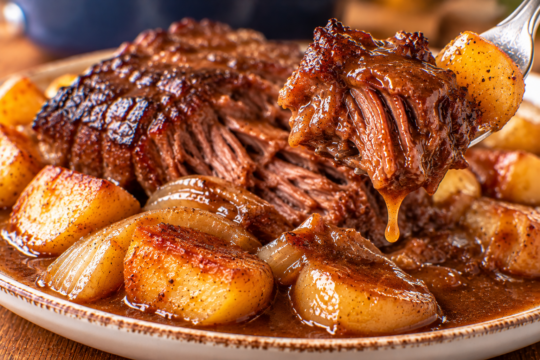
Grandpa’s Dutch Roast is an old-fashioned, slow-cooked beef dinner featuring a deeply browned chuck roast surrounded by tender potatoes, sweet onions, and carrots in a rich, savory pan gravy.
A long, gentle roast transforms an inexpensive cut of beef into fork-tender meat that practically falls apart when served.
This is the kind of hearty one-pot dinner made for a Sunday supper or chilly evening.
Browning the beef and onions first builds plenty of flavor, while beef broth, Worcestershire sauce, and a touch of brown sugar create a dark, full-bodied gravy. Everything finishes together in the Dutch oven, so the potatoes soak up the beefy cooking juices as the roast becomes tender.
Prep Time: 20 minutes
Cook Time: 3 hours 30 minutes
Total Time: 3 hours 50 minutes
Servings: 6 to 8
Ingredients
- 1 boneless beef chuck roast, 3 1/2 to 4 pounds
- 2 teaspoons kosher salt
- 1 teaspoon black pepper
- 1 teaspoon garlic powder
- 1 teaspoon onion powder
- 1/2 teaspoon smoked paprika
- 2 tablespoons vegetable oil
- 2 large yellow onions, cut into thick wedges
- 3 cloves garlic, minced
- 2 tablespoons tomato paste
- 3 cups beef broth
- 2 tablespoons Worcestershire sauce
- 1 tablespoon brown sugar
- 1 teaspoon dried thyme
- 2 bay leaves
- 2 pounds Yukon Gold or baby potatoes, halved if large
- 4 large carrots, cut into thick pieces
- 2 tablespoons unsalted butter
- 2 tablespoons cornstarch
- 2 tablespoons cold water
Directions
- Preheat the oven to 325°F.
- Pat the chuck roast thoroughly dry with paper towels. Season all sides with the salt, black pepper, garlic powder, onion powder, and smoked paprika.
- Heat the vegetable oil in a large Dutch oven over medium-high heat. Add the roast and sear without moving for 4 to 5 minutes, or until a deep brown crust develops.
- Turn the roast and brown the opposite side for another 4 to 5 minutes. Briefly sear the edges as well. Transfer the roast to a plate.
- Reduce the heat to medium. Add the onion wedges to the Dutch oven and cook for 5 to 6 minutes, turning occasionally, until the edges begin to caramelize.
- Add the garlic and tomato paste. Cook for about 1 minute, stirring constantly, until the tomato paste darkens slightly.
- Pour in about 1 cup of the beef broth. Scrape the bottom of the Dutch oven with a wooden spoon to loosen all of the browned bits.
- Add the remaining beef broth, Worcestershire sauce, brown sugar, thyme, and bay leaves. Stir to combine.
- Return the roast to the Dutch oven along with any juices collected on the plate. Spoon some of the cooking liquid over the top.
- Cover the Dutch oven tightly and transfer it to the preheated oven. Roast for 2 hours.
- Carefully remove the Dutch oven from the oven. Arrange the potatoes and carrots around the roast, pushing them partially into the cooking liquid.
- Cover and return to the oven for another 60 to 90 minutes, or until the beef pulls apart easily with a fork and the potatoes and carrots are tender.
- Transfer the roast and vegetables to a serving platter and loosely cover with foil. Discard the bay leaves.
- Place the Dutch oven over medium heat on the stovetop. Bring the cooking liquid to a gentle simmer.
- Whisk the cornstarch and cold water together until completely smooth. Slowly stir the mixture into the simmering cooking liquid.
- Simmer for 2 to 4 minutes, stirring occasionally, until the gravy becomes thick and glossy.
- Stir the butter into the gravy until melted. Taste and adjust the salt and pepper if necessary.
- Break or slice the roast into large tender pieces and arrange them with the potatoes, carrots, and caramelized onions.
- Spoon plenty of hot brown gravy over the beef and vegetables before serving.
Chefs Notes
- Chuck roast is ideal because its marbling and connective tissue become exceptionally tender during a long, slow braise.
- Do not rush the initial sear. A dark brown crust on the beef provides much of the deep roasted flavor in the finished gravy.
- Patting the roast dry before seasoning helps it brown rather than steam.
- Keep the onion wedges fairly large so they become soft and caramelized without completely disappearing into the gravy.
- The small amount of brown sugar does not make the roast sweet. It balances the savory broth and complements the caramelized onions.
- Add the potatoes and carrots after the beef has already cooked for about 2 hours. Adding them at the beginning can make the vegetables overly soft before the beef becomes tender.
- The roast is ready when a fork twists easily in the meat. If it still feels tough, cover it and continue cooking for another 20 to 30 minutes.
- If the gravy becomes too thick, thin it with a splash of beef broth. If it is too thin, simmer it for several additional minutes.
- For serving, breaking the roast into several large rustic pieces often keeps it juicier than cutting it into thin slices.
- Leftovers are especially good the following day after the beef has rested overnight in the gravy.